



- This event has passed.
Reviving the Óenach: Bealtaine
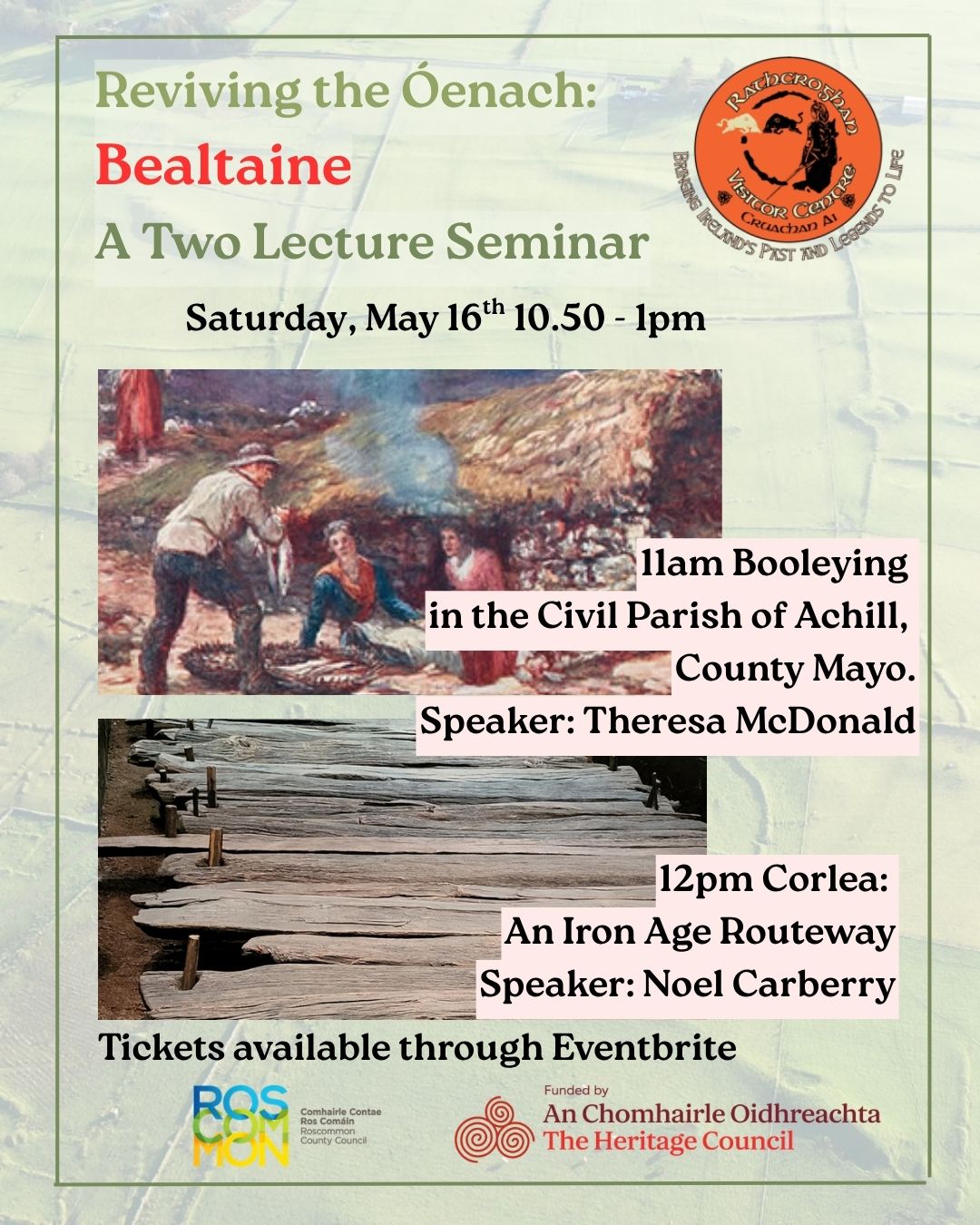
Our two lecture seminar to mark the ancient Irish Cross Quarter Festivals returns. Reviving the Óenach: Bealtaine this year will look at the tradition of Booleying & its associated folklore around May Day followed by a focus on Corlea Trackway, an Iron Age route way believed to link the ancient royal landscape of Rathcroghan to the Hill of Uisneach. Tickets from Eventbrite.
– Booleying: An Ancient Farming Tradition in the Civil Parish of Achill, Co. Mayo Theresa McDonald, MA. Ph.D.
Booleying also known as Transhumance is a traditional, seasonal pastoral practice involving the movement of livestock between fixed summer and winter pastures to maximize grazing efficiency. This lecture will be based on Theresa McDonald’s recent book, Booleying in Ireland and will focus on the tradition of booleying in Achill, with particular emphasis on Slievemore Deserted Village and the folklore associated with the practice around May Day. Theresa McDonald is a professional archaeologist and founder of the well-known Achill Archaeological Field School, the oldest field school in Ireland. She has carried out extensive research on the archaeology and history of the Civil Parish of Achill, with a particular emphasis on the practice of transhumance or booleying as it is called in Ireland. Theresa holds a BSc. from the Institute of Archaeology in London and an MA and PhD from the University of Galway.
– Corlea: An Iron Age Routeway Noel Carberry
Inside an interpretive centre, an 18-metre stretch of the ancient wooden structure is on permanent display not far from the village of Kenagh, Co. Longford. The Corlea Iron Age Road, a togher, is an inspiring relic of prehistory built c.148 BC and the largest of its kind to have been uncovered in Europe. Archaeologists believe it to have been a routeway of great importance. It may have been a section of a ceremonial highway connecting the Hill of Uisneach, the ritual centre of Ireland, and the royal site of Rathcroghan. Listen to Guide Noel Carberry reveal more about Corlea and how it sank into the peat after only a short time in use where it remained perfectly preserved in the bog for the next two millennia.