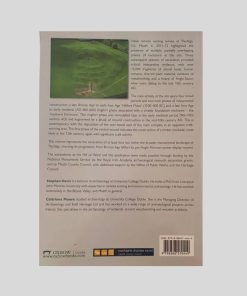



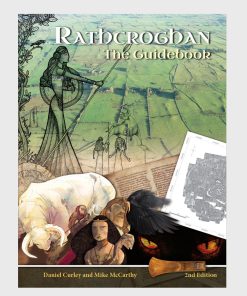
Front Cover of Rathcroghan - The Guidebook 2nd EditionBack cover of Rathcroghan - The Guidebook 2nd Edition

Rathcroghan – The Guidebook 2nd Edition

18.00

New Edition 2023 now available to order.

This second edition of the Rathcroghan Guidebook contains updated and new imagery and text alongside entries on every aspect of Rathcroghan, from its archaeological and historical landscapes, through to its literary and mythological associations. This publication is the quintessential user’s guide to this fascinating archaeological landscape. Drawing upon historical, literary and cutting-edge archaeological research, Rathcroghan: The Guidebook is designed to bring the reader on a journey through time at Rathcroghan, from the first settlers to this broad limestone plain in the Neolithic period, through to the political mechanics of late medieval Machaire Connacht.

Thereafter, you will be taken on a journey of a different kind. You will see how our ancestors wove a tapestry of literature on top of this canvas of Rathcroghan, connecting physical landmarks and ancestor burials with the intoxicating narrative of Queen Medb of Connacht and the Ulster Cycle of Tales, filled with war and strife, jealousy and intrigue, gods and mere mortals.
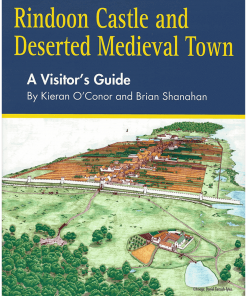
Rindoon Castle And Deserted Medieval Town - A Visitors Guide

Rindoon Castle And Deserted Medieval Town – A Visitors Guide

10.00

The town and castle of Rindoon were founded in 1227 as a royal Anglo-Norman borough and fortress on the sometimes turbulent frontier between the Anglo- Norman colony in Ireland and a region controlled by the Irish O’Conor kings of Connacht.

The well preserved remains at Rindoon are regarded as being one of the most important medieval complexes still standing in Britain and Ireland. It is, also, without doubt one of the finest examples in Europe of a deserted medieval town.

The deserted town and castle of Rindoon are situated on the peninsula of St. John’s Point, which runs out south eastwards from the western, Connacht shore of Lough Ree.

It is hoped that this guidebook will provide not only information, but enjoyment for those who visit Rindoon and St. John’s Point. Its detailed nature will hopefully also make it a contribution to the ongoing academic research currently being carried out on Ireland’s medieval towns, castles, abbeys and priories.

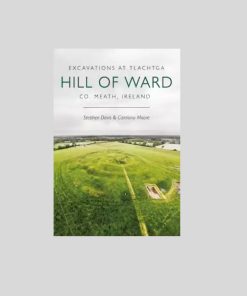
Front cover of Excavations at Tlachtga, Hill of Ward, Co. Meath, IrelandBack cover of Excavations at Tlachtga, Hill of Ward, Co. Meath, Ireland

Excavations at Tlachtga, Hill of Ward, Co. Meath, Ireland

42.00

Excavations at Tlachtga, Hill of Ward, Co. Meath, Ireland

by Stephen Davis and Caitríona Moore

Initial remote sensing survey at Tlachtga, Co. Meath in 2011–12 highlighted the presence of multiple, partially overlapping phases of enclosure at the site. Three subsequent seasons of excavation provided critical interpretive evidence, with over 15,000 fragments of animal bone, human remains, charred plant material, evidence of metalworking, and a hoard of Anglo-Saxon silver coins dating to the late 10th century AD.

The main activity at the site spans four broad periods and two main phases of monumental construction: a late Bronze Age to early Iron Age ‘Hillfort Phase’ (1100–400 BC) and a late Iron Age to early medieval (AD 400–600) ringfort phase associated with a smaller foundation enclosure – the ‘Southern Enclosure’. This ringfort phase was remodeled later in the early medieval period (9th–10th century AD) and augmented by a phase of mound construction in the mid-10th century AD. This is contemporary with the deposition of the coin hoard east of the main complex in an apparent craft-working area. The final phase of the central mound indicates the construction of a timber stockade, most likely in the 12th century, again with significant craft activity.

This volume represents the excavation of at least four loci within the broader monumental landscape of Tlachtga, charting its progression from Bronze Age hillfort to pre-Anglo Norman power display mound.