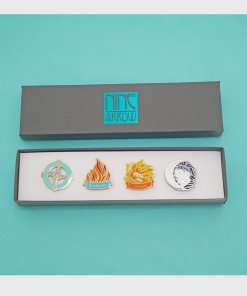
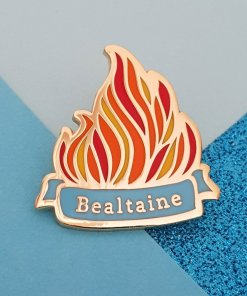
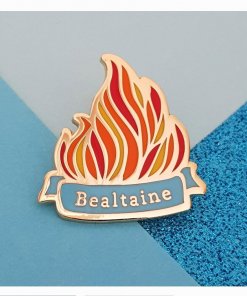
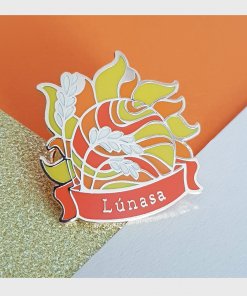
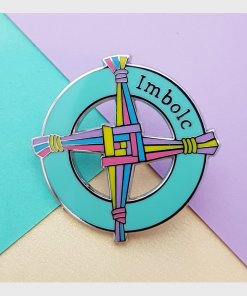
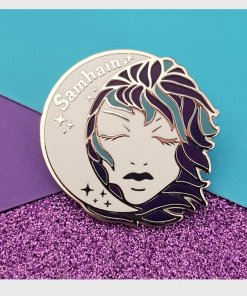
Mark Ireland’s Cross Quarter Festivals with these colourful enamel pin gift sets representing Imbolc, Bealtaine, Lúnasa and Samhain. Beautifully illustrated by Catherine Geaney of Nine Arrow, each pin is 32mm x 32mm, with silver plating and a metal clutch.
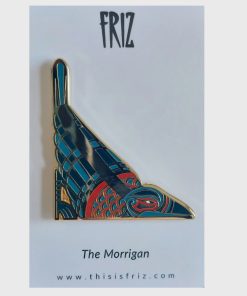
Hard enamel pin depicting the Mórrígán, the Irish goddess of war whose fit abode was the Cave of Oweynagat.
Size: 45mm, packaged in cellophane on a backing card. Designed and produced by the artist, Friz.
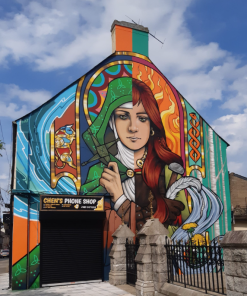
Hard enamel pin based on artist Marian Noone’s (Friz) mural artwork in Dundalk titled, Brigid of Faughart. Both aspects of Brigid are depicted, the Christian Saint Brigid and the Goddess Brigid. Hard enamel pin
Size: 60mm
Comes packaged in cellophane on a backing card.
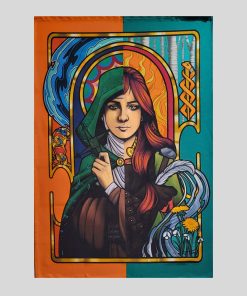
Fabric Wall Hanging based on artist Marian Noone’s (Friz) mural artwork in Dundalk titled, Brigid of Faughart. Both aspects of Brigid are depicted, the Christian Saint Brigid and the Goddess Brigid with elements that reflect the medieval illuminated text, the Book of Kells.
Size: 700mm x 480mm (approx.)
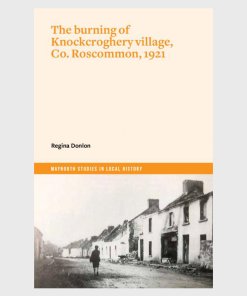
The Burning of Knockcroghery Village, Co. Roscommon, 1921
Regina Donlon
On the evening of 20 June 1921, Colonel-Commandant Thomas Stanton Lambert was assassinated at Benown near Glasson in Co. Westmeath. Hours later, the small village of Knockcroghery in south Co. Roscommon was set ablaze by the British forces, seemingly in an act of retribution for Lambert’s murder. The burning was an unfortunate case of mistaken identity, however, that ultimately resulted in the decimation of the local economy and heralded the end of clay-pipe production in the area. This study explores the complex world of rural Ireland against the backdrop of the Irish War of Independence, while demonstrating how local communities were impacted by evolving national narratives. Although it later emerged that the Knockcroghery company of the Irish Republican Army was not involved in Lambert’s killing, this study examines how the social and economic fabric of that community was altered as a result.
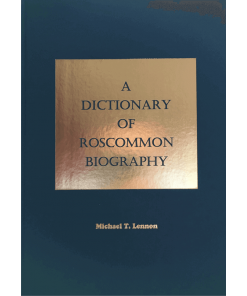
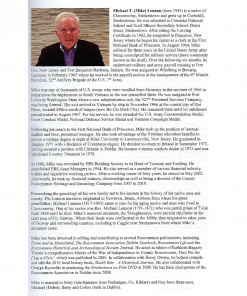
This DIGITAL VERSION of ‘A Dictionary of Roscommon Biography’ contains 5000 individual entries which describe the careers of people in all fields of endeavour, including politics, religion, law, literature, journalism, business, trades, medicine, sport, engineering, painting, music and entertainment and is a must for anyone with an interest or connection with Co. Roscommon.
Upon your purchase of this digital copy, Rathcroghan Visitor Centre will forward your contact details to the author, who will then personally email your electronic copy in PDF format.*
*please note that by purchasing this version, you agree to the sharing of your contact details with the author Mike Lennon in order to facilitate the file transfer.
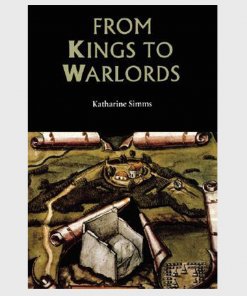
From Kings to Warlords: The Changing Political Structure of Gaelic Ireland in the Later Middle Ages – Katharine Simms
The Norman invasion of Ireland (1169) did not result in a complete conquest, and those native Irish chieftains who retained independent control of their territories achieved a recovery of power in the later middle ages. Katharine Simms studies the experience of the resurgent chieftains, who were undergoing significant developments during this period. The most obvious signs of change were the gradual disappearance of the title rí (king), and the ubiquitous presence of mercenary soldiers. On a deeper level, the institution of kingship itself had died, as is shown by this study of the election and inauguration of Irish kings, their counsellors, officials, vassals, army, and sources of revenue, as they evolved between the twelfth and sixteenth centuries. Sources such as the Irish chronicles, bardic poetry, genealogies, brehon charters and rentals, family-tract and sagas are all used, in addition to the more familiar evidence of the Anglo-Norman administration, the Church, and Tudor state papers.
Dr Katharine Simms lectures in the Department of Medieval History, Trinity College, Dublin.
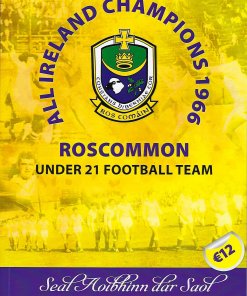
Roscommon Under 21 Football Team – All Ireland Champions 1966
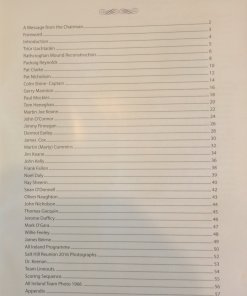
Compiled by Paul Mockler, this 90 page fully illustrated colour journal was produced to commemorate the great achievements of the mighty Roscommon Under 21’s who won All Ireland glory in 1966.
All surplus proceeds from the sale of this journal will be donated to Western Alzheimer’s.