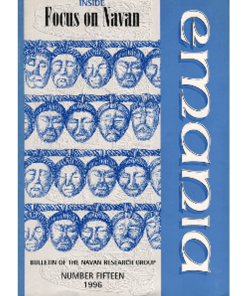
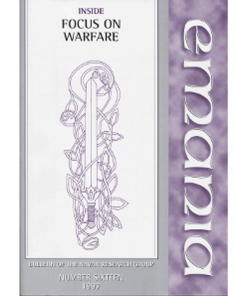
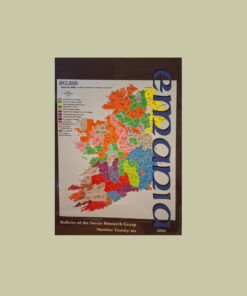
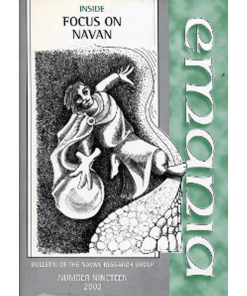
Emania is the premier interdisciplinary journal publishing original research on Ireland’s Celtic past. The main focus of the journal is on the Ulster Cycle of tales, the ancient ‘Royal Sites’ of Ireland and the archaeology and environment of Ireland in the period from the Late Bronze Age until the Early Medieval period.
Emania is the premier interdisciplinary journal publishing original research on Ireland’s Celtic past. The main focus of the journal is on the Ulster Cycle of tales, the ancient ‘Royal Sites’ of Ireland and the archaeology and environment of Ireland in the period from the Late Bronze Age until the Early Medieval period.
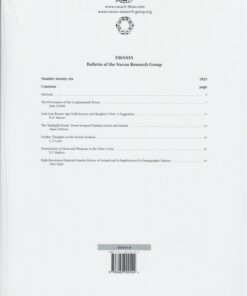
Ó Néill, John: The provenance of the Loughnashade horns, 7-16. Warner, R.B.: Irish Late Bronze Age gold sources and Haughey’s Fort: a suggestion, 17-22. Dellovin, Alaën: The Tamlaght hoard: vessel-weapon pointing in Iran and Ireland, 23-44. Lynn, C.J.: Further thoughts on the Pictish symbols, 45-54. Mallory, J.P.: Descriptions of dress and weapons in the Ulster Cycle, 55-94. Fehér, Tibor: High resolution paternal genetic history of Ireland and its implications for demographic history, 95-117
Emania is the premier interdisciplinary journal publishing original research on Ireland’s Celtic past. The main focus of the journal is on the Ulster Cycle of tales, the ancient ‘Royal Sites’ of Ireland and the archaeology and environment of Ireland in the period from the Late Bronze Age until the Early Medieval period.
Emania is the premier interdisciplinary journal publishing original research on Ireland’s Celtic past. The main focus of the journal is on the Ulster Cycle of tales, the ancient ‘Royal Sites’ of Ireland and the archaeology and environment of Ireland in the period from the Late Bronze Age until the Early Medieval period.
Emania is the premier interdisciplinary journal publishing original research on Ireland’s Celtic past. The main focus of the journal is on the Ulster Cycle of tales, the ancient ‘Royal Sites’ of Ireland and the archaeology and environment of Ireland in the period from the Late Bronze Age until the Early Medieval period.
Emania is the premier interdisciplinary journal publishing original research on Ireland’s Celtic past. The main focus of the journal is on the Ulster Cycle of tales, the ancient ‘Royal Sites’ of Ireland and the archaeology and environment of Ireland in the period from the Late Bronze Age until the Early Medieval period.
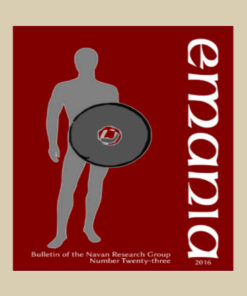
The contents of issue 23 is as follows:
Focus on Hillforts and Earthworks;
O’Brien, William: Clashanimud and the Bronze Age hillforts of Munster, 5-30.
Macdonald, Philip: Excavations at Knock Dhu promontory fort, Ballyhackett, Co. Antrim 2008, 31-49.
Schot, Roseanne; Waddell, John & Fenwick, Joe: Geophysical survey at Rathcroghan 2010-2012, 51-59.
Warner, R.B.: The linear earthwork known as ‘the Danes Cast’: early descriptions, general observations and a newly recognised extension at Newtown, Co Armagh, 61-66.
Gibbons, Michael & Gibbons, Myles: The Brú: A Hiberno-Roman cult site at Newgrange?, 67-78.
Kerr, Thomas R.: A comparative overview of warfare in Early Medieval Ireland – AD 600-800, 79-93.
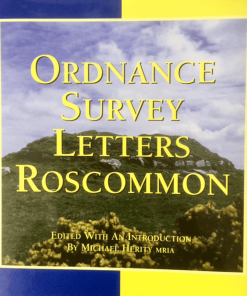
Letters Relating to the Antiquities of the County of Roscommon Containing Information Collected During the Progress of the Ordnance Survey in 1837, edited with an introduction by Michael Herity MRIA.
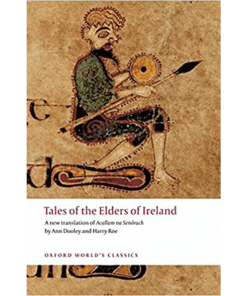
“Dear holy cleric,’ they said, ‘these old warriors tell you no more than a third of their stories, because their memories are faulty. Have these stories written down on poets’ tablets in refined language, so that the hearing of them will provide entertainment for the lords and commons of later times.’ The angels then left them.”
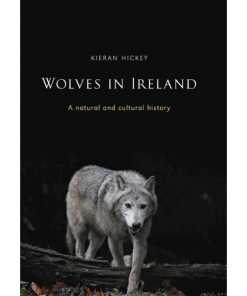
‘A fascinating overview of the wolf in Ireland through the ages. Hickey redresses the demonization of this iconic animal.’ – Ciaran Mc Mahon, Team leader, Dublin zoo
Kieran Hickey is a lecturer in the Department of Geography, NUI Galway. He is the author of Deluge: Ireland’s weather disasters, 2009–2010 (Open Air, 2010).
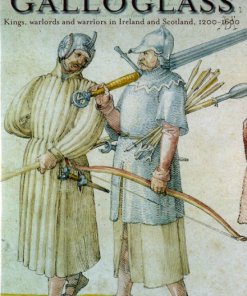
The World of the Galloglass: Kings, Warlords and Warriors in Ireland and Scotland, 1200-1600
This volume contains the proceedings of a recent Edinburgh conference at which scholars discussed the intersection of Scottish and Irish politics and culture in the later Middle Ages. It was a world epitomized by the neglected figure of the galloglass and several of the papers explore the role of these West Highland dynasties and their rapid proliferation throughout Ireland from the late thirteenth century onwards, but the volume also examines the high politics of Scottish royal involvement in Ireland, and the common culture of Gaeldom, particularly as manifested in the corpus of surviving bardic verse.
Contributors include: Steve Boardman, David Caldwell, Alison Cathcart, Seán Duffy, David Edwards, Wilson McLeod, Kenneth Nicholls, Alasdair Ross, Katharine Simms, and Alex Woolf.
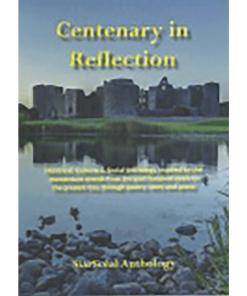
Centenary in Reflection 2016 Anthology is a momentous is snapshot of global and local history and culture; a space created to review times past, voiced by writers and students locally and internationally.
Provocative words on two world wars, emigration, and reminiscences about ‘how we once lived’ are contained within these pages. The story of how, as a nation re-birthed through the 1916 rebellion, it is that event and the fundamental truths proclaimed in the Proclamation of the Republic that haunts the psyche of our imagination, informing our views about the needs of the present as we rise to the challenges that lie ahead.
‘The Irish Republic is entitled to and hereby claims the allegiance of the Irishman and Irishwoman. The Republic guarantees religious and civil liberty, equal rights and equal opportunities to all its citizens.’
Let the story begin.
SiarScéal is an annual festival that celebrates the history and culture of the Roscommon environs, through all art forms and media and with the participation of communities and schools. The Festival also hosts the international Hanna Greally Literary Awards.