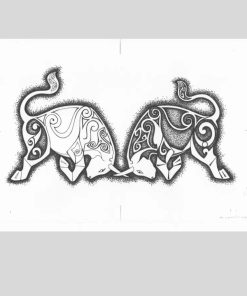
Bespoke, exclusive design, based on and inspired by the Battle of the Bulls, Finnbennach, the white horned bull of Connacht and Donn Cuailnge, the Brown Bull of Cooley, which took place at Rathnadarve (Ráth na dTarbh – the Fort of the Bulls) in Rathcroghan at the conclusion of our national epic tale, An Táin Bó Cuailnge.
Blank Greeting Card and envelope, produced for Rathcroghan Visitor Centre by artist Martin Wilson (Hatch Burn Carve).
Bespoke, exclusive design, based on and inspired by; carvings on the Castlestrange Stone, detail from the Knock gold torc and ogham inscriptions from Oweynagat Cave: all emblematic of Iron Age Roscommon.
Blank Greeting Card and envelope, produced for Rathcroghan Visitor Centre by artist Martin Wilson (Hatch Burn Carve).
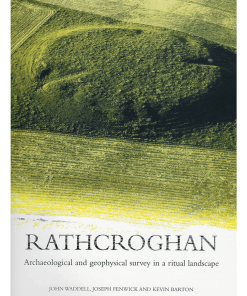
Rathcroghan (Crúachain) is often referred to as both a ‘Celtic’ Royal Settlement and a sacred burial place; it is one of several major royal sites in ancient Ireland, such as Tara, Co. Meath, Knockaulin, Co. Kildare, and Navan Fort near Armagh, that are frequently mentioned in early literature.
While these sites had special importance in early historic times, and in some cases bore and extraordinary weight of myth and legend, we now know that they are older archaeological assemblages of impressive complexity and size.
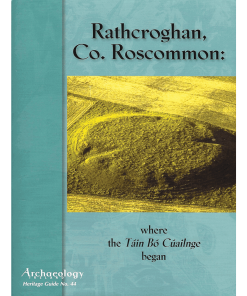
This book is the result of a major programme of archaeological field research at Rathcroghan in County Roscommon in the West of Ireland. The project involved the use of a range of geophysical techniques to explore a number of extraordinary monuments in the Royal Site.
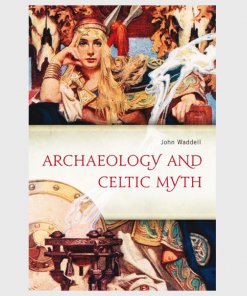
In this book John Waddell contends that elements of pre-Christian Celtic myth preserved in medieval Irish literature shed light on older traditions and beliefs not just in Ireland but elsewhere in Europe as well. He mainly focuses on aspects of the mythology associated with four well-known Irish archaeological landscapes: Newgrange and the Boyne Valley, the royal sites of Rathcroghan in Co. Roscommon, Navan in Co. Armagh, and Tara in Co. Meath. Their mythological associations permit the pursuit of the archaeological implications of several mythic themes, namely sacral kingship, a sovereignty goddess, solar cosmology and the perception of an Otherworld.
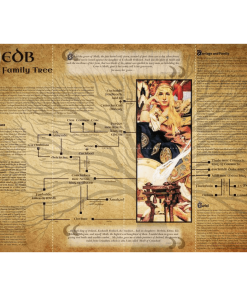
It would be impossible to discuss Irish history or mythology without considering its most vivid female character, the Iron Age Warrior Queen Medb (Maeve). Although once generally regarded as an historical character, modern scholars see her in a somewhat different light, in the guise of a divine goddess like figure. Whichever way you consider her there is no doubt that she captures the imagination of generations. Perhaps this is due to the fact that Medb seems to embody all aspects, from the royal and sacred, to the mythological and divine. This enigmatic queen crosses all borders with her universal appeal, and it is certainly no exaggeration for us to regard her as a national emblem.
This beautiful bespoke fold out Family Tree Wallchart display, gives details of Queen Medb’s life, character, numerous marriages and offspring, death and burial.
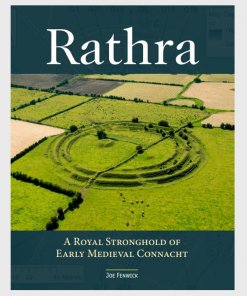
‘Rathra – A Royal Stronghold of Early Medieval Connacht’ by Joe Fenwick explores the date, role and significance of this spectacular multivallate earthwork, a little-known archaeological site concealed among the hidden heartlands of rural Co. Roscommon.
This beautifully illustrated full colour publication, the latest in a series published by Roscommon Co. Council is a must for anyone with an interest in the archaeology and history of the wider Roscommon landscape.
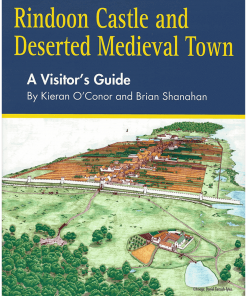
The town and castle of Rindoon were founded in 1227 as a royal Anglo-Norman borough and fortress on the sometimes turbulent frontier between the Anglo- Norman colony in Ireland and a region controlled by the Irish O’Conor kings of Connacht.
The well preserved remains at Rindoon are regarded as being one of the most important medieval complexes still standing in Britain and Ireland. It is, also, without doubt one of the finest examples in Europe of a deserted medieval town.
The deserted town and castle of Rindoon are situated on the peninsula of St. John’s Point, which runs out south eastwards from the western, Connacht shore of Lough Ree.
It is hoped that this guidebook will provide not only information, but enjoyment for those who visit Rindoon and St. John’s Point. Its detailed nature will hopefully also make it a contribution to the ongoing academic research currently being carried out on Ireland’s medieval towns, castles, abbeys and priories.
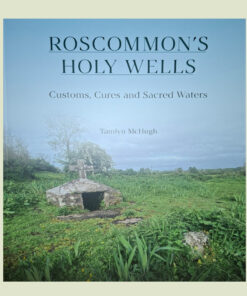
Roscommon’s Holy Wells – Customs, Cures and Sacred Waters
Tamlyn McHugh
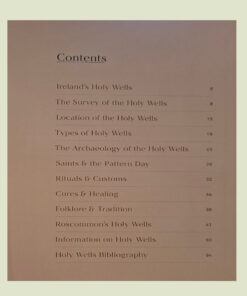
“The traditions, oral heritage and customs surrounding our holy wells are an important aspect of our intangible cultural heritage. Ireland has over 3,000 holy wells, with 79 examples recorded in County Roscommon A small number of these holy wells are still venerated and the traditional pattern days are still observed. Though like many holy wells across the country, in County Roscommon most have become disused and fallen into neglect, sometimes used as watering places for cattle, whilst others have dried up and many have become entirely forgotten. Therefore, it is important to collect the available information about these holy wells before it is lost from memory.”
This beautiful full colour publication is the latest in a series published by Roscommon Co. Council and is a must for anyone with an interest in the heritage, history and archaeology of the Roscommon landscape.
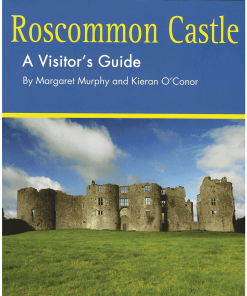
“In Roscommon Castle a Visitor’s Guide Margaret Murphy and Kieran O’Conor chart the history and architectural development of Roscommon Castle from the mid-thirteenth century onwards. The full colour illustrated guidebook has chapters called: The History of the Castle, The Siting of the Castle, A tour of the Late Thirteeneth-Century Castle, The Late Medieval O’Conor Occupation and A Tour of the Late Sixteenth-Century Castle. The guidebook also includes two detailed historical reconstruction drawings by Daniel Tietzsch Tyler.
This guidebook is intended to be a comprehensive guide for visitors to Roscommon castle, as well as a point of reference for academics and local historians. Historic Reconstruction Drawings used in the guidebook intended to give the visitor an impression of what the castle may have been like in the thirteenth and sixteenth centuries.”
“Authors: Dr Kieran O’Conor is a lecturer in archaeology in NUI, Galway. Margaret Murphy MA graduated from NUIG in 2002, after writing her Masters Dissertation on the subject of Roscommon Castle. She wrote the guidebook based on the findings of her Masters. She works as a freelance archaeologist and lives in Galway.”
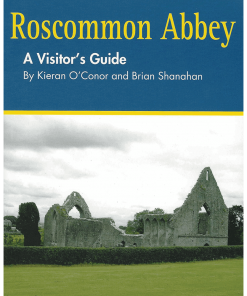
“In ‘Roscommon Abbey: A Visitor’s Guide’ Dr. Kieran O’Conor and Brian Shanahan chart the history and architectural development of Roscommon Abbey from the mid-thirteenth century onwards.
The full colour illustrated guidebook has chapters called: Ecclesiastical activity at Roscommon before the Dominicans; Who were the Dominicans? The foundation of the priory in 1253; the subsequent history of the priory; the siting of the priory; the physical remains at Roscommon priory today; a tour of the thirteenth-century priory and a tour of the fifteenth century priory.
The guidebook also includes two detailed historical reconstruction drawings by Daniel Tietzsch Tyler and a box text by Colmán Ó Clabaigh OSB outlining a typical day in the life of a Dominican Friar in medieval Ireland.”
‘Authors: Dr Kieran O’Conor is a lecturer in archaeology in NUI, Galway. Brian Shanahan worked in the Medieval Rural Settlement project with the Discovery Programme.’